

Ron Hart was hooking up a vehicle on the Don Valley Parkway when a car struck him.
It was rush hour and traffic was moving slowly, which is likely the only reason he's still here to tell the story. The impact still knocked him over the hood of the car he'd been working on.
"I've also had many near misses, even while doing everything I could to stay safe," Hart says. "Until you've worked on the side of a highway with traffic passing you at more than 100 kilometres an hour, you don't fully understand how dangerous it can be."
Hart is now CAA Niagara's Health, Safety, and Environmental specialist, responsible for the wellbeing of the people who do the job he used to do. He's held the role for nearly six years. The message behind Slow Down, Move Over isn't a campaign slogan to him. It's personal.
Career Journey from Aviation to Health and Safety
Hart's career path had many stops before he landed in occupational health and safety, but all of his experience made him the perfect man for the job. 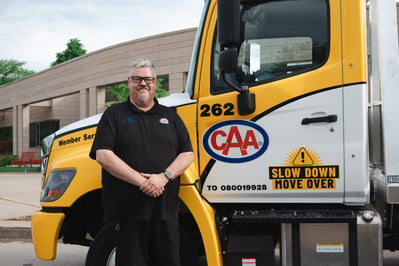
“I actually have two backgrounds,” said Ron. “The first is in civil aviation, where I worked with Sunwing Airlines and Air Canada in maintenance and engineering. That gave me a strong background in compliance and regulations.
Hart started out driving a tow truck almost by chance, filling in for a friend. Once he was behind the wheel, he never really wanted to stop.
" I fell in love with it very quickly," he says. "I loved the adventure, seeing new places, meeting new people, and helping others."
There was one side to the work that was hard. "I never felt good about charging people large amounts of money for help," he says. Joining the CAA changed his view on the industry. "I was able to do the job I loved while helping Members, and that was incredibly rewarding."
Nearly six years ago it brought him to CAA Niagara, where he started as an Emergency Roadside Services (ERS) driver before stepping into health & safety.
Helping people is where Ron's passion for towing and safety stems from. Health and Safety allows the best of both worlds. Ensuring ERS drivers are safe and can provide assistance to Members while getting home safe themselves. Further, he ensures safety for all employees at CAA Niagara— he truly has made helping others his entire career.
The Reality of Working Roadside
"No two calls were ever the same, and that kept the job interesting" Hart says. Shifts run long — 12 hours each —calls range from boosts and tire change to lockouts and full tows.
“The days were long but at the end of the day, you felt like you had accomplished something. That was always really rewarding.”
There's a consistent that comes with the job, the risk. Drivers routinely work a metre or two from traffic moving at highway speed, and the first thing the job teaches, Hart says, is situational awareness. "The roadside environment is fast-paced and high-risk, so that level of personal awareness is crucial. Knowing how to use the equipment safely matters, but awareness is what keeps you safe." 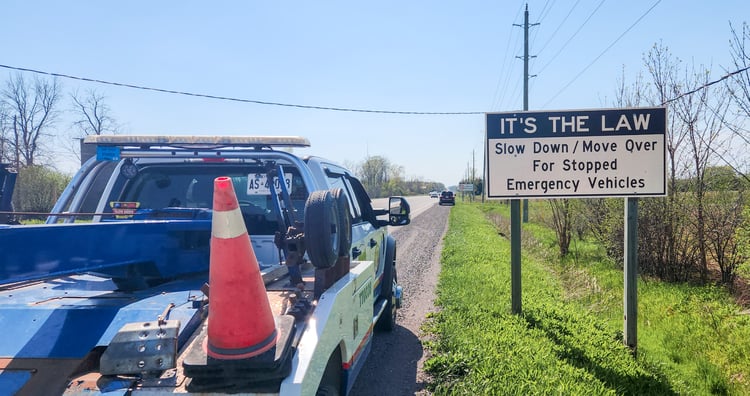
When asked if he felt safe on the side of the road, Hart's answer was eye opening.
"I always tell people that fear can be a safety tool. You should feel a healthy sense of caution when you're working roadside because it keeps you alert. The moment you become complacent, the risk of an incident goes up."
"Roadside work is never completely safe," he adds. "It's a high-risk environment, and that's why so many of our procedures, policies, and equipment standards at CAA Niagara are built around protecting drivers."
It's not an exaggeration. A January 2024 AAA Foundation for Traffic Safety study, supported by CAA, identified 123 roadside assistance workers were struck and killed while working in the U.S. between 2015 and 2021. A surprising fact from this study is that most of these accidents didn't happen in a winter storm or in hazardous conditions, they happened on high-speed roads, after dark, in clear, dry conditions.
Slow Down and Move Over: How both actions help protect Roadside Workers
Ontario's Slow Down, Move Over law was amended in 2015 to include tow trucks. Hart mentions that this didn't result in compliance, and drivers often still don't follow the law when it comes to tow trucks.
"When the law was amended in 2015 to include tow trucks, a lot of the public still didn't realize it applied to us, CAA Niagara even ran a campaign in 2023 to help spread that message across the Niagara region," said Hart.
"Commercial drivers are generally very good about slowing down and moving over, but the majority of the motoring public still isn't consistent. Some drivers slow down, but they don't always move over."
A study by the AAA Foundation of Traffic Safety reports that while 90 per cent of drivers say they slow down or move over, only 64 per cent actually do.
"A lot of people misunderstand the law. They think it means slow down or move over, but it really means slow down and move over."
There's no fixed speed reduction written into Ontario's legislation, Hart suggests lowering your speed by at least 20 kilometres an hour below the posted limit. "If you're driving 130 in a 110 and only slow down to 110, that's still not slowing down enough," Hart says.
The penalties support this suggestion, under Section 159 of Ontario's Highway Traffic Act, a first offence carries fines of $400 to $2,000, three demerit points, and a possible licence suspension of up to two years.
The Personal Side of the Law
Hart has lost friends in the towing industry to drivers who didn't slow down and didn't move over. He's walked in funeral processions two kilometres long, made up entirely of tow trucks.
The industry knows that grief well. Two CAA contractors in Ontario were killed in separate incidents in December 2025 while assisting stranded motorists — a reminder of exactly what's at stake every time someone doesn't slow down.
"Most tow truck drivers are in this work because they genuinely want to help people," Hart says. "They care about what they do, and they deserve respect. The roadside is our workplace, and when something happens there, it affects families, friends, coworkers, and entire communities."
Hart’s message to drivers is simple:
"We're often working only a metre or two away from traffic moving at highway speed. I wish drivers would stay focused, remove distractions, and remember that ERS drivers are people just like them. We're simply trying to do our job and get home safely at the end of the day."
"Whether it's a tow truck driver, emergency responder, construction worker, or someone changing a tire, giving them space makes a real difference. Slow down, move over if you can, and help keep roadside workers safe."
“That’s why this message matters so much,” said Ron. “Please do your part to make roadside work safer.”
 Ontario